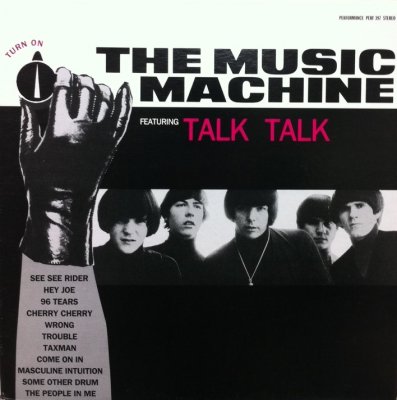
they wore gloves before MJ did. black ones. oh well
Even if the glove did not fit, one must admit to a catchy tune.
Oh wait, you said MJ not OJ.
Never mind.
Snips follow:
Although they only briefly managed to attain national chart success with one single, the Music Machine is today considered by many critics to be a one of the groundbreaking acts of the 1960s. Their style is now recognized as a pioneering force in proto-punk; yet within a relatively short period of time, they began to employ more complex lyrical and instrumental arrangements that went beyond the typical garage band format.
"Talk Talk" was released on September 10, 1966 on Original Sound, and propelled to number 15 on the Billboard Hot 100. It also peaked at number 21 on Cashbox and number 18 on Record World.[20] The song's relatively short time-length—a mere one minute and 56 seconds—made "Talk Talk" a favorable stable on Top 40 radio and its competing underground FM stations.[21] The Music Machine's hit was arguably the most radical single to appear on mainstream broadcasting in 1966, the phenomenon described by music historian Richie Unterberger as a "rally cry to social alienation with a mixture of sarcasm, rebellion, self-pity, and paranoia".[11] Indeed, Bonniwell's progressive lyrics and arrangements have been attributed to influencing the Doors and Iron Butterfly, as well as future punk bands.[16][22] After the single's release, the Music Machine embarked on a grueling three-month tour across the U.S., packaged with the Beach Boys, Question Mark and the Mysterians, and Clyde McPhatter.[11][16] It concluded with the group receiving a poor response from the more conservative southern crowds, who criticized the band's black outfits.[16] Nonetheless, for the most part, their unified image served well for the Music Machine's national recognition, especially as the group made numerous appearances on the television programs Where the Action Is, American Bandstand, and Shindig!.[2]